

Decisions, Parenting

Take a Survey

Sometimes my decisions depended my children’s momentary interests or their current stamina. How could I acquire this information without giving an unhealthy impression of who was in charge of our family? I took surveys when the boys were young.

I would say, “This is not a vote. I am making the decision. It is a survey, which will influence my decision. Would you boys rather go to the park and have a picnic by the lake or have a picnic in the backyard and have time to bike later?” “Would you rather unload the dishwasher or help Daddy outside?”

Depending on your child’s age, you might need to explain that a survey is a research method used to collect specific information from particular people. Car manufacturers conduct surveys to determine which features car buyers expect on new cars.

One adult son used this technique on me when he needed outpatient surgery. One recovery option was for me to make a six-hour, round trip drive and bring him to our family home for recovery. “This is not a vote,” he began. “It is a survey. Would you rather I recovered here or ….”

How do you receive necessary input for your decisions?

Decisions

Simple Solutions (Reprise)

Twenty-six years ago, our garden was important and the rabbits and squirrels and birds were our challenge. The deer joined them when a new subdivision was built.

We enjoyed our garden so much that we didn’t give up when the critters started eating all of our strawberries—yes, every single one. However, when eventually the tomatoes and melons were devoured, we admitted defeat.

We missed our tomatoes the most, and my sister encouraged me to grow tomatoes on our upstairs deck. I refused. I was not willing to take the risk because squirrels and birds frequented our deck.

What had I learned along the way? No matter how large the challenge, try to find a simple solution before you quit.   (See Simple Solutions here.)

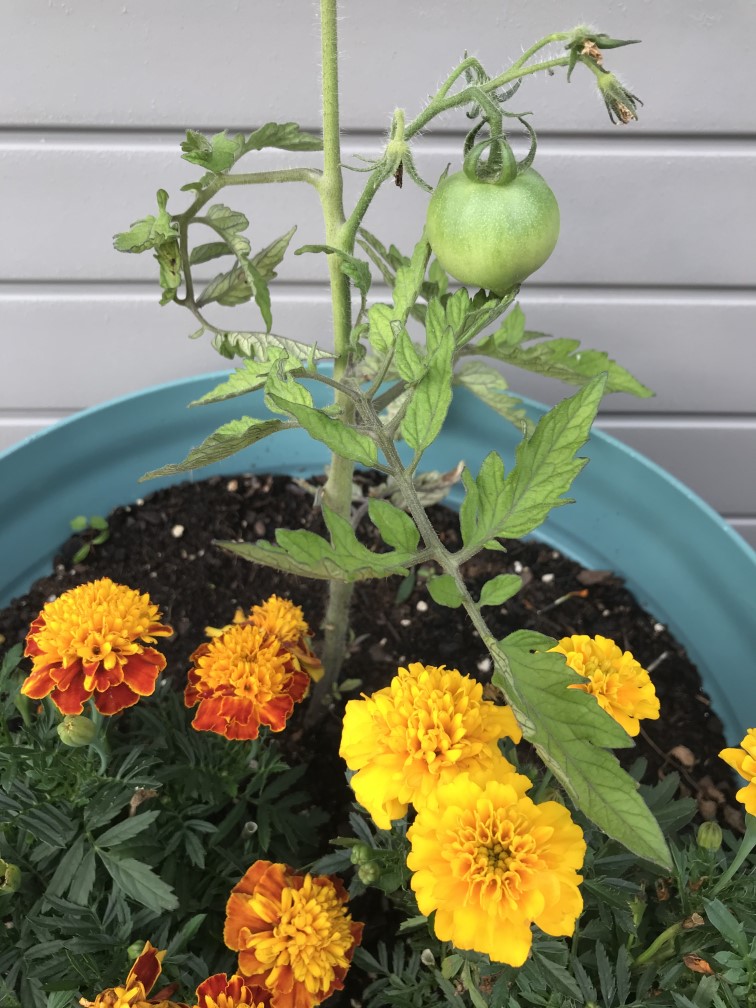
This year, I decided to try a simple solution for growing tomatoes. I planted marigolds. Squirrels do not like marigolds and birds tend to leave them alone.

My marigold guards.

My first fruits.

I am still learning the value of simple solutions.

Decisions

Simple Solutions

My husband sang in the church choir Wednesday nights. He loved it. My three-year-old attended a Bible program those nights. He loved it. My 18-month-old was bathed by Mommy instead of Daddy those nights. He despised it—especially the hair washing. The infant was indifferent, but especially demanding with Daddy away. Eventually, I despised Wednesday nights.

The best solution seemed to be ending the Wednesday evening activities after the Christmas program. After all, bath time with Daddy was especially significant to one son. Even more, I didn’t want a challenging evening after being home all day with three young children.

In retrospect, my husband and oldest child leaving their activities was the worst solution. They were important outlets. Bedtime routines could have been simplified. Wednesday baths could have been skipped— at least the hair washing. These solutions never occurred to me until years later. (Although they may have occurred to you as you read.)

Those days, I was too overwhelmed to find another way. What did I wish I had known and learned along the way? No matter how large the challenge, try to find a simple solution before you quit a priority.

Any simple fixes to your challenging situations?

Homeschooling

Think Like A Professional

Years ago, a teacher in a traditional school did not participate in a Saturday church event. “I teach all week,” she told me on Sunday.

Saturday is my only opportunity for errands and chores.”

Her explanation was my wake-up call to think like a professional. My sons deserved the respect she gave her students. However, I had shortchanged their education to please others. Midweek chores and errands had squeezed out homeschooling lessons in order to attend the time-consuming Saturday event my friend eschewed.

I thought how I would respond if my sons attended a traditional school and math was not taught Thursdays. The teacher had a weekly commitment that hour. Math would continue all summer to compensate.

What if the history teacher had received a phone call from a friend in a crisis? The make-up class was at seven o’clock after dinner. Worse, what if this happened regularly? Art was cancelled because a neighbor needed a ride.

Homeschooling gave me the privilege of being flexible but not to the neglect of my calling.

How are you thinking like a professional?

Whatever you do, work heartily, as for the Lord and not for men.

Colossians 3:23 ESV
Friendship, Parenting

Emotional Vulnerability

A broken washing machine made me realize that I had friends I would impose on and friends I wouldn’t. (See Dirty Laundry Vulnerability Here.)

After I explained the dirty laundry versus non-dirty laundry friend distinction to a dear prayer partner, she replied, “Same goes with your emotional dirty laundry.” During the rest of our conversation, we referred to several prayer items as “emotional dirty laundry.”

I thought about our conversation as I checked off errands that day. I wanted to be the friend that could accept someone’s emotional dirty laundry, even if I couldn’t make it clean. I wanted my friends to know they were safe with me.

More importantly, I wanted to be the mother whom my children saw as safe to handle their emotional dirty laundry. During most of their childhood and adulthood, they only brought me their physical laundry to sort and clean. Focusing on my to-to list—including physical laundry—created barriers to emotional laundry.

Katie and I have been giving each other our emotional dirty laundry for almost three decades. (CHAP Homeschool Convention 2014)

How is your emotional dirty laundry? Giving? Receiving?