
Parenting

Children Don’t Change Part 2

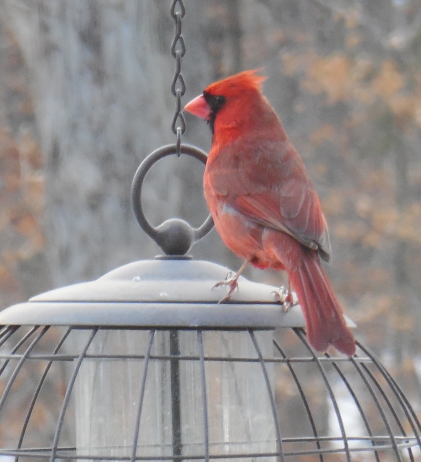
I previously shared how “dog” and “bird” were among the earliest words of my eldest son. (See Hang A Bird Feeder Here.) His interest in dogs and birds never wavered.

Our dog, Tramp, may have been a birthday present for my middle son and slept with my youngest son, but my oldest showed the most concern. He was the only family member who once noticed Tramp had not eaten for more than a day and cooked delicacies to tempt his appetite. He alone stayed with Tramp when he had to be put down. He was our dog’s best friend.

Tramp, our faithful dog 1998-2013

No one cares for the birds in our back yard and woods like my eldest. He notices their first reappearances. He cautions me not to scare them with my camera clicks. He reminds me to hang our bird feeders during snows and the extreme cold, and then, keeps watch to make sure the feeders stay filled. Birds are safer because of him. We enjoy birds more because of him.

Our deck February 2021

How little did we understand the significance of my son’s first words.

What unchangeableness can you praise?

Basics, Book Recommendations

Guitar Notes By Mary Amato

It is obvious that some kids are dying inside. Their anger, sour attitudes, and sloppy work are testimony.

What I learned along the way was that the child who is kind, complaint, and hardworking might be experiencing his or her own internal death.

Guitar Notes by Mary Amato beautifully portrays this dual reality. Tripp, a guitarist, and Lyla, a cellist, are dealing with very similar—yet, very different—painful circumstances. They are unable to communicate effectively with their caring parents.

One parent struggles to understand defiant behavior. The other has no clue that outward perfection hides intense pain.

If you have a tween or teen, I recommend you read Guitar Notes privately, and then, perhaps, with your child. It is a good conversation starter.

What methods do you have for discerning what is beneath the surface?

Homeschooling

Independent Learners

Multiple speakers and magazine articles had declared children were natural learners. (Natural Learners? Or Not? here.) Even better, teens were independent learners and required little parental input.

Early one morning, I sold a used geometry book online. The buyer asked if I had my lesson plans, and I offered my experience as well.

“My sons could not be given geometry and left alone to master it,” I typed. “They are not always independent learners.”

The admission was important to both me and my buyer. She confessed that her teens were not independent learners for most subjects.

Swapping stories felt like a conspiratorial moment against peers.

I added, “I would be upset if a traditional teacher handed my sons books to master and told them to return when ready to be tested. Why should we be expected to do that?”  

I am grateful to the home-educating pioneers for their courage, legacy, and advice. I am grateful they invested in my generation. However, those with both time and willingness to write articles and speak at conferences were the parents most likely to have strong independent learners. I wish I had realized this sooner.

Which declarations do not match your reality?

Decisions, Friendship

Trust Your Instinct

A long-distance friend had a January birthday, and I wanted a gift that reflected her personality and tastes. I was stumped.

One December afternoon, I perused Christmas gift bags at JOANN Fabrics. One rack featured women in 1960’s outfits.  The writing on one snowy scene declared, “Shopping in a Winter Wonderland.” Faye loved retro, snow, and shopping. I bought the bag. Now I needed the gift.

On the way to the car, I thought how Faye would love the bag even without a gift inside.

Go back and buy more of those gift bags for her birthday,” I thought. “She would love them all.”

A sample of the selection

I used the long checkout line as an excuse to dismiss my irrational thoughts. My friend would never judge a gift from me, but empty gift bags?

A week later, I was back at JOANN Fabrics and took the plunge. I mailed Faye an assortment of empty gift bags. Inside her birthday card, I warned that the birthday present was strange. Intrigued, Faye opened it early. She, her family, and her even friends loved my idea.

Want a perfect gift? Follow your instincts. Risk being wrong.

When has a friendship risk paid off?

Book Recommendations, Decisions

Mini Habits: Guest Blog

Beth Sterne* shares what she has learned about breaking bad habits.

Mini habits make success and permanent change attainable. Stephen Guise explains a small-step approach in Mini Habits: Smaller Habits, Bigger Results.

The goal is to change your brain with repetition.

Force yourself to take 1-4 strategic actions daily.  (Ten minutes max, all together) These actions are too small to fail or to skip. Mini goals should be “stupid small.” You succeed when you do that small thing.

You may do more, but no more is required. Do not raise the goal.

Guise’s brain resisted a 30-minute workout. One push-up? His brain agreed. He now does full workouts. He requires himself to write 50 words per day; he usually writes two thousand. Success is one push up and fifty words. Doing a little bit daily has more impact than doing a lot on one day.

A big push day ends. A little bit daily grows into a lifelong habit.

The subconscious does not fight small steps. Taking one step at a time, you cooperate with the subconscious – while transforming it. You’ve sneaked into the control room.

What mini habit will you start?

* Beth blogs at https://putoffprocrastination.com