
Homeschooling, Parenting

A Teachable Moments Perspective*

I ended my last blog with the question How do you decide whether to ignore or seize a teachable moment? (See here.)

Kathleen, one of my favorite moms, responded with her answer. Seize when your children are interested.

I never had a problem with my mom’s teachable moments, but I’ve never cared for my dad’s. I think the difference in their cases is that my mom taught when WE were interested; my dad taught when HE was interested. 

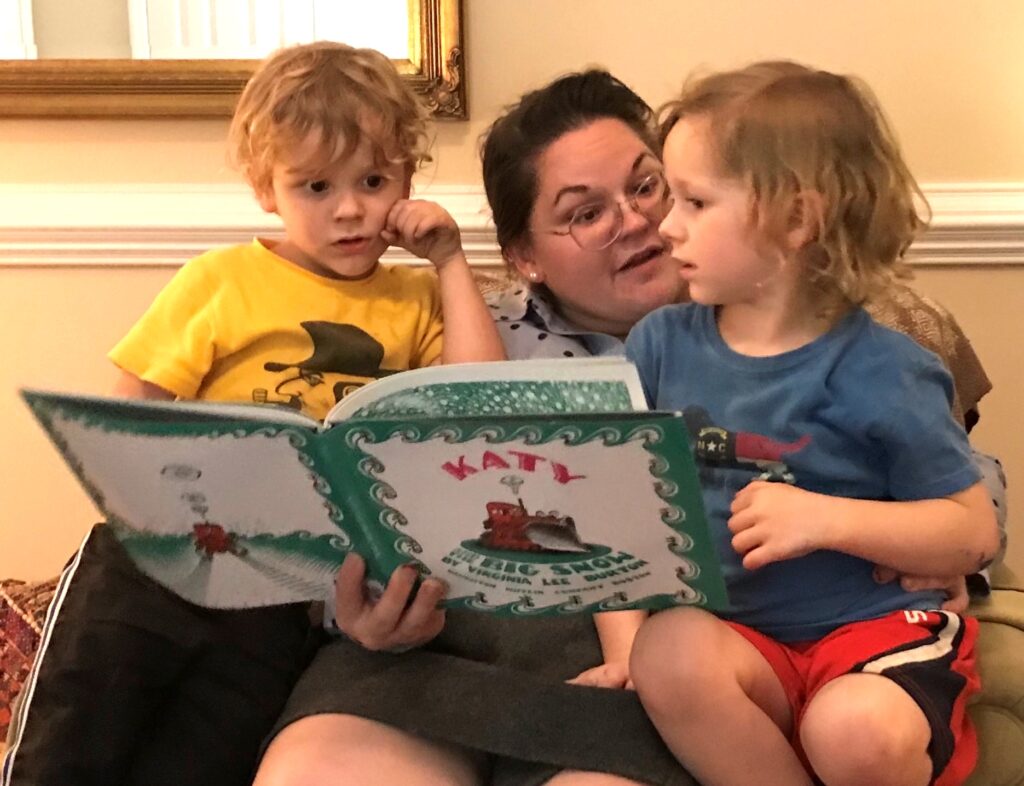
Kathleen, a second-generation homeschooler, with her boys.

This perceptive mom pinpointed the overload of teachable moments in my household—and other households with curious parents. Not only did I want my children to learn from any educational opportunities, but also, I wanted to learn. Loaded with new knowledge and understanding due to homeschooling, how could I not pass along new connections as soon as I discovered them?

What could be better than delving deeper into past or current lessons? My sons’ answers: Legos, Playmobils, baseball, and Redwall books—eventually replaced by music, running, and computers.

Kathleen ended with this advice: Keep teachable moments short, responding to cool things as a parent and not as a teacher.

*Used with permission.

Homeschooling, Parenting

Parenting After Mile 20

Although marathons are 26.2 miles, experienced marathoners know that the real race begins at mile 20. Until then, runners are surviving to reach the true start line. Early success does not predict winners because marathons are won or lost in the last 6.2 miles.

Too late, I learned that the parenting marathon is the same. The early years are surviving until the real race begins—adolescence.

Why? Research shows there is less memory retention before age ten. Our children are not sustained by the relationship memories parents made during the early years.

Second, our children’s brains change at puberty. What they need from us changes radically. Previous parenting methods are ineffective for the years our children will vividly remember.

Unfortunately, both parents and marathoners are exhausted—and sometimes injured—during the crucial miles. Runners know they have another grueling 6.2 miles. We parents may falsely assume the outcome is determined by the time we reach mile 20. We call victory or defeat too early. (See Here)

Experienced marathoners have a strategy for the hardest, ending miles. I wish I had known to prepare mine.

Boston qualified with a new strategy

May you have wisdom as you run your parenting marathon.

Homeschooling, Parenting

Calling the Race Too Soon

When Ester Ledecka won the gold medal in alpine skiing at the 2018 Winter Olympics, sportscasters were embarrassed. Why? With almost an hour left in the competition, Anna Veith was assumed to be the winner. Live coverage shifted to another Olympic venue while Veith’s fans celebrated. One commentator declared, “Baring something exceptional, Anna Veith has defended her gold.”

But something exceptional did happen. Ledecka, who ranked 43rd in World Cup standing for alpine skiing, defeated Veith—without the world watching. Ledecka also made Olympic history by winning two golds at the same Olympics using different equipment.

It was fun to watch the after-the-fact Olympic coverage. However, it wasn’t fun when my friends and I called the race too soon with our children.

We became complacent, assuming the best about our children who excelled— according to our standards. We become anxious, assuming the worst about our children who struggled. Both early calls prevented my friends and me from successfully parenting to the finish line of adulthood.

Our unexpected “wins” were sweet, but our unexpected “losses” were more bitter than slipping into second place or even off an Olympic podium.

Are you staying until the end of the race?

Homeschooling, Parenting

Forgive Them

Be kind to one another, tenderhearted, forgiving one another, as God in Christ forgave you.

Ephesians 4:32 ESV

At some point, we must acknowledge any grievances we have against our children and forgive them.

Forgive them for grumbling.

Forgive them for not trying.

Forgive them for not finishing their work.

Forgive them for forgetting what you thought they had mastered.

Forgive them for not practicing after begging for expensive music or art or dance or whatever lessons.

Forgive them for not liking the curriculum you took weeks to select.

Forgive them for not being independent learners—as if that was their fault.

Forgive them for not meeting the advertised parenting or homeschool expectations—as if that was their fault as well.

Forgive them for not being kind to their siblings.

Forgive them for wishing they had different parents.

Forgive them for all the other things you once held and might still hold against them.

At some point you pardon the people in your family for being stuck together in all their weirdness and when you can do that, you can learn to pardon anyone.

Anne Lamott
Book Recommendations, Parenting

Carry On, Mr. Bowditch

Twenty-six years ago, my husband’s co-worker recommended a fictionalized juvenile biography. Carry On, Mr. Bowditch by Jean Latham became an immediate favorite. I read it to our sons and insisted my husband read it during his bus ride to work.

As a child, Nathanial Bowditch constantly overcame obstacles pursuing an education. As an adult, he faced danger sailing internationally after the American Revolution.

However, I believe the life lessons flowing seamlessly from the narrative were the reasons for the book’s impact. Serving others, duty, self-directed learning, perseverance, perspective, the value of teaching, the non-academic benefits of education, and patience with people of different talents were learned, and later, modeled by Nathanial as he struggled from childhood through adulthood.

I’m just like a chair you stumble over in the dark,” Elizabeth said. “It isn’t the chair’s fault, but you kick it anyway.

Nat blinked. “What are you talking about?”

Your brain. It’s too fast. So you stumble on other people’s dumbness. And—you want to kick something.

But you shouldn’t because even if people are dumb, they aren’t chairs are they?”

… He always remembered how she said, “Your brain—it’s too fast.” He would bite back his impatience.

Carry On, Mr. Bowditch, Jean Latham

Any book recommendations?