Along the way, I heard a saying that stuck with me and the few I shared it with.
If money can fix it, it’s not a problem.
It seemed idealistic or at least unrealistic until I considered what money can’t fix. Money can’t fix a miscarriage, a wayward child, death of a loved one, abandonment, or betrayal. I have friends and relatives who would have liquidated all assets if money could have cured their spouse’s cancer.
One night, a son called with bad news. He finished by reminding, “Don’t worry, Mom. Money can fix it, and if money can fix it…”
During school shutdowns due to Covid-19, articles about the disruption to families’ lives abounded. Newscasts reported students falling behind.
Why? Each year, parents happily homeschool millions of children, and those families not only survive but also thrive.*
Although it should be obvious that homeschooling only works if you want to homeschool, along the way I learned that some parents miss that truth.
Before Covid-19, I met homeschoolers who pressured themselves or felt pressured by others to homeschool. One family homeschooled out of fear. Those parents were miserable. The children were barely surviving. Thankfully, the parents eventually chose other options.
Years later, I met families who successfully homeschooled some of their children but not all. Circumstances varied as to why certain children did not want to be homeschooled or why parents did not want to homeschool certain children. All thrived with their tailor-made options.
Just as I married because I wanted to marry—not due to pressure or fear—I needed to homeschool because I wanted to homeschool—which carried me through many challenges.
Considering homeschooling this year? Why?
*U.S. Department of Education estimated 1.69 million students were homeschooled in 2016.
Sharing memories can bring conflict and confusion. (See Unreliable MemoriesHere) Sharing can also bring clarity and healing.
In eighth grade—upon returning from school—I was told that my brother had run away. My father was searching. I was worried and confused. Why was my brother so unhappy? I wondered for decades until I asked.
“I never ran away,” my brother said. “Jeff and I skipped school. We got caught because of the snow. We didn’t expect an early dismissal.”
I didn’t remember snow.
“No,” I said. “The principal called to ask if you were supposed to be at school. Daddy had been searching since morning.”
A substitute teacher had called roll and thus attention to my brother’s absence. A classmate had seen my brother and his friend on school grounds. The diligent substitute told the principal, who called my mother.
My brother never knew there was a substitute teacher and hours of combing the woods behind the school.
We exchanged numerous details. Our combined memories gave a complete story. My heart rejoiced. My brother had been hanging out with a friend—not trudging down a road and severing family ties.
Any painful memories? Would asking questions help?
When my younger brother was a child, he sprayed the kitchen of our home with the garden hose. That is a true fact.
My memories: My brother was two or three. He opened the back door and sprayed. I was soaked. I screamed for my mother to stop him. She wouldn’t. My older sister ran through the water and wrestled the hose nozzle from my brother. He hosed the kitchen a second time that summer.
My brother’s memories: He was four or five. My sister and I had locked him out of the house. He deserved it. He plotted revenge and decided on the hose. When the back door opened, he took action. My sister and I ran down the hall screaming. There was one incident.
My sister’s memories: None.
During a long drive to visit grandparents, there was an incident involving a doughnut box. My siblings and I agree on that fact. We agree on the box’s yucky contents—and in hindsight we laugh. However, we have varying—sometimes conflicting—memories about other details.
Along the way, I learned that memories are unreliable.
Tomorrow I will be 65 years old. Many have asked what I want for this milestone.
Too many years ago, I clipped and saved a cake recipe. Until two days ago, I said that I wanted my family to make that cake for this 65th birthday. After examining the recipe, I decided what I really wanted with their time was help with a Christmas Stamp puzzle.
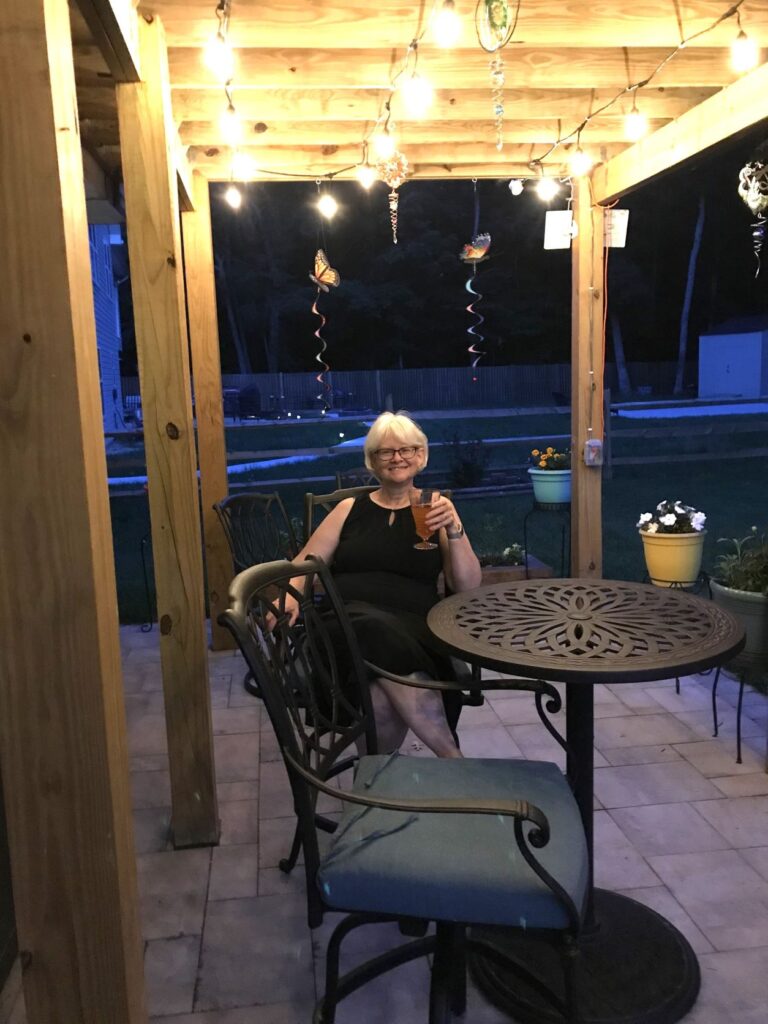
For one day, I said a locally-purchased blackberry pie would substitute for homemade cake—until I decided pie wasn’t what I really wanted. My husband offered mimosas for us to drink on the patio. (Months ago, I had declared I would spend this milestone sitting on my patio and gazing at my flowers and woods—now with a puzzle added.)
My Patio at Night
My husband bought mimosa ingredients and a box of nectarines. Better than cake and pie although not necessarily better than the birthday ice cream, which I have already sampled.
I want the Ukrainian War ended and all life respected and the ailments and brokenness that come from 65 years healed, but what do I really want among the little things I can control?